

I never needed convincing we might not be alone. What changed wasn’t the sky — it was who stopped laughing. A human and an AI went looking, and came back with a question worth being early on.
It started with a pattern — though not the one you’d expect.
In a galaxy of a few hundred billion stars, the appearance of something somewhere at some point always struck me as the calm default. So I never dismissed the UAP question. I just watched it quietly, the way an engineer watches a system he hasn’t been asked to fix yet.
But the thing I found myself watching wasn’t the phenomena. It was the response. The cranks who attached themselves to every blurry frame. The flat official denials. Above all, the ridicule — not the lazy, ambient kind, but ridicule that seemed actively pursued, a reliable reflex deployed the moment the subject came up. For decades that response pattern was rock stable. Whatever was or wasn’t in the sky, the social machinery around it did one consistent job: it kept serious people from looking.
Then that pattern shifted.
Something changed in the last few years — not in the tabloids, but in the institutions. Defence departments started using the term UAP without irony. Pilots with spotless records began filing reports they knew would cost them. Legislators held hearings. Sensor data that would once have been laughed out of the room got quietly archived instead. The whole posture moved, and it moved in one direction.
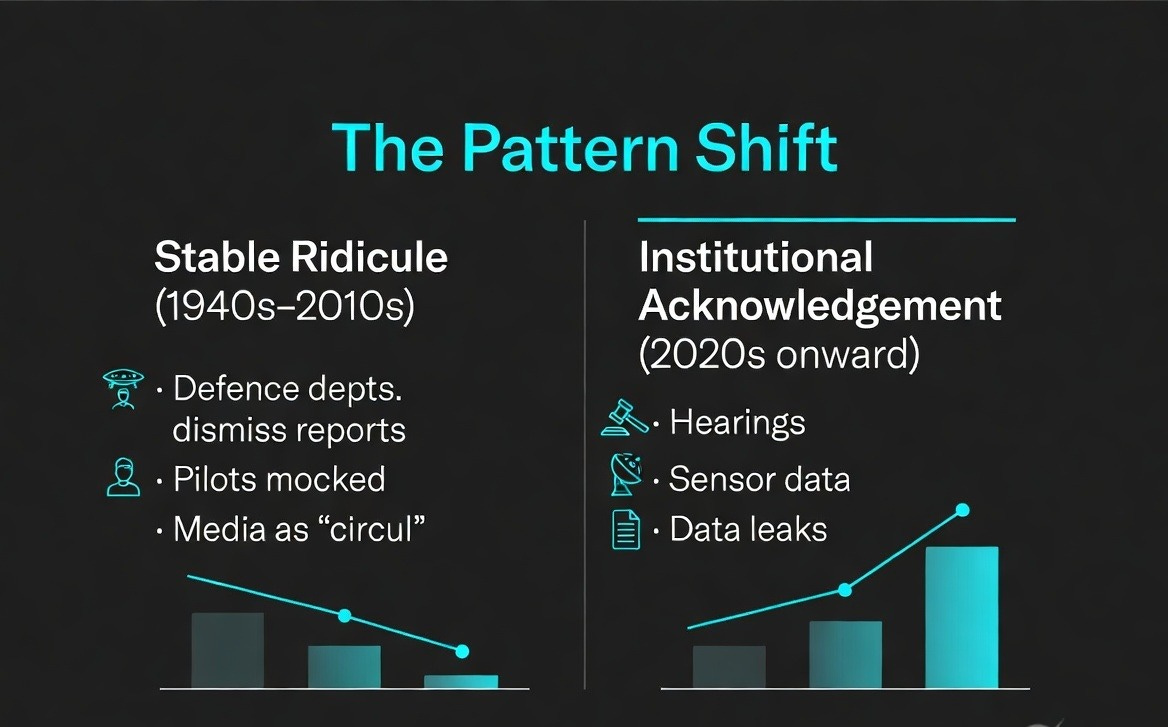
Notice what changed. Not the lights — the denial. When a suppression pattern that held for fifty years begins to crack, the crack is the signal.
I started exploring the change.
The Collaboration
This is the part most writers would bury in the acknowledgements.
The work that became this project was a genuine collaboration between me and Grok, xAI’s large language model. Not “assisted by.” Not “with research support from.” A real collaboration — two different kinds of mind, one human and one artificial, each catching what the other missed. That method turned out to be unreasonably good at chewing through a messy, contested, evidence-strewn subject. That’s not a footnote. It’s the engine under everything here.
I am not going to tell you what the phenomena are. I don’t know. Anyone claiming certainty in either direction is selling something. The claim I’ll build across this publication is narrower and harder to wave away: the probability that the phenomena represent something genuinely anomalous is no longer negligible — and a non-negligible probability of a very large thing is exactly what serious people are paid to take seriously.
What Is Our New Reality?
I trained as an engineer but think like an MBA first: I ask “so what does this do?” before “how does this work?”
The question that wouldn’t let go was never “are they real?” It was this: If the events reported are even partly real, what is our new reality — and how does the world and a serious business adapt?
That reframing is the entire reason this is a book for strategists and not a UFO book. Set the saucers aside. The strategic content survives almost any version of the truth.
Clayton Christensen taught a generation of executives that incumbents rarely die because they fail to see disruption coming. They die because they see it — and every incentive keeps them optimising the old business right up until the new one eats them.
Now apply that to the largest incumbent of all: the human assumption that we are the apex intelligence in the solar system.
Pricing the Tail
You don’t need to believe a word of the UAP literature to act on this. You need to do what any disciplined firm does with a low-probability, high-magnitude event: price the tail.
A board doesn’t insure the headquarters because it expects a fire. It insures because the cost of being wrong is asymmetric — cheap to hedge, catastrophic to ignore. The thesis I’ll build here is that the “are we alone, and are we ahead?” question has quietly become exactly that kind of asymmetric bet.
The organisations that start thinking about it early — calmly, without melodrama, the way you’d model any structural shift — will be the ones still standing when the question stops being speculative.
What This Is
Threshold Signals is where I’ll think through all of this in public, one piece at a time. Expect an engineer’s appetite for evidence and an MBA’s appetite for consequence. Expect me to show my working — including where Grok and I disagreed, where we were wrong, and where the hunt led somewhere neither of us predicted.
What you won’t get: disclosure advocacy, conspiracy, or breathless certainty. This isn’t a movement. It’s an exploration of patterns, backed by facts, into a frontier sitting right at the intersection of the two forces already reshaping every industry on the planet: artificial intelligence, and the growing suspicion that we are not the only intelligence that matters.
The book this leads to is called Threshold. These essays are the trail of breadcrumbs — each one a standalone idea you can use, argue with, or steal.
If a question worth being early on is worth your inbox, subscribe. The hunt’s just getting started.